
Everybody Sold the Power
A scarce, permitted gigawatt campus, marked for parts in a founder’s soap opera. A tactical long on Fermi ($FRMI) into a mid-August clock.

MISPRICED ASSETS · EQUITY RESEARCH · ~$6B · Tactical / special situation
Fermi is my kind of mess: a Texas power company with seventeen gigawatts on paper, no customers, a founder who got himself fired, and a stock down about seventy-five percent. It’s also well shorted: thirty-four percent according to S3.
FRMI 0.00%↑ trades around $9.50, which makes it roughly a $6 billion company. It’s a development-stage power developer building a campus in the Texas Panhandle, and what it owns is the one thing the AI build-out can’t get enough of: firm, deliverable electricity, on land where a data center can sit right on top of it.
That last point is worth sitting with, because it’s what makes the comparisons absurd. Nebius locked up forty-six billion dollars of cloud contracts and the market pays it sixty billion. Hut 8 signed a single fifteen-year lease and roughly doubled. CoreWeave is in the same neighborhood. The pattern doesn’t change: a company commits its power to a hyperscaler, and it gets paid for the commitment. Fermi has as much power as any of them and hasn’t committed a watt, because the year it should have spent selling, the founder spent fighting. So it trades for a tenth of Nebius.

THE BOARD EVERYONE IS HANDED
Fermi came public last October at something like a twenty-billion-dollar valuation, with no revenue and a single non-binding letter of intent. That tenant — reported everywhere as Amazon, though the company won’t confirm it — walked in December, and the stock fell by half. In March the founder, Toby Neugebauer, got into a public shouting match with the Commerce Secretary at Nvidia’s conference. In April the board fired him for cause, and the CFO resigned the next day. Neugebauer, who still controls north of forty percent of the stock, sued and launched a proxy fight to take the company back. It traded as low as $4.47. The one sell-side analyst still on it kept his buy rating, cut his target almost in half, and ran it under a headline that just said “Waiting for Godot.”
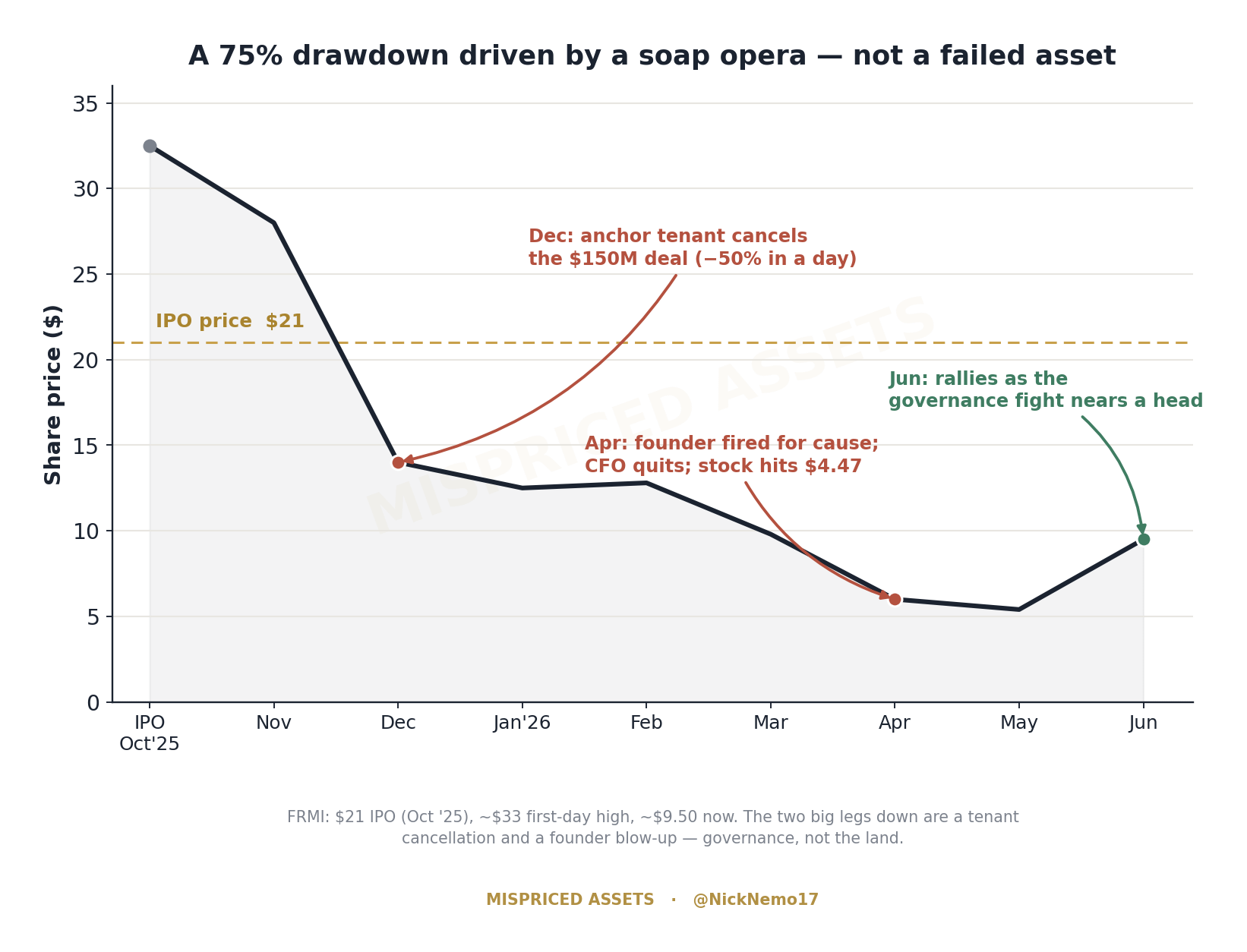
Every line in that paragraph is about a man. None of it is about the permits, the turbines, or the land. The market sold the asset because the people running it embarrassed themselves, and those are not the same thing.
WHAT’S ACTUALLY THERE
What the founder built before he blew himself up is hard to replicate, and that’s what the price ignores. The site is about 7,500 acres, leased for ninety-nine years from Texas Tech, which until recently rented the same dirt to farmers for about seventy grand a year. It sits on a gas field where two major pipelines cross, and Fermi has run its own gas and water lines into it. It holds an air permit for six gigawatts of generation, the second largest of its kind in the country, and has filed for five more. The first six gas turbines have already cleared customs in Houston.
If you tried to order large gas turbines today, the manufacturers couldn’t hand them to you until 2029. The line is sold out. Permitting a site like this takes three to five years on its own. So while every hyperscaler in the country is hunting for firm power it can plug into this decade, Fermi is sitting on a permitted gigawatt that’s nearly ready, with more behind it, and roughly $1.4 billion of infrastructure already standing on the ground. The only thing it hasn’t done is sell any of it.
EVERYBODY SOLD THE POWER
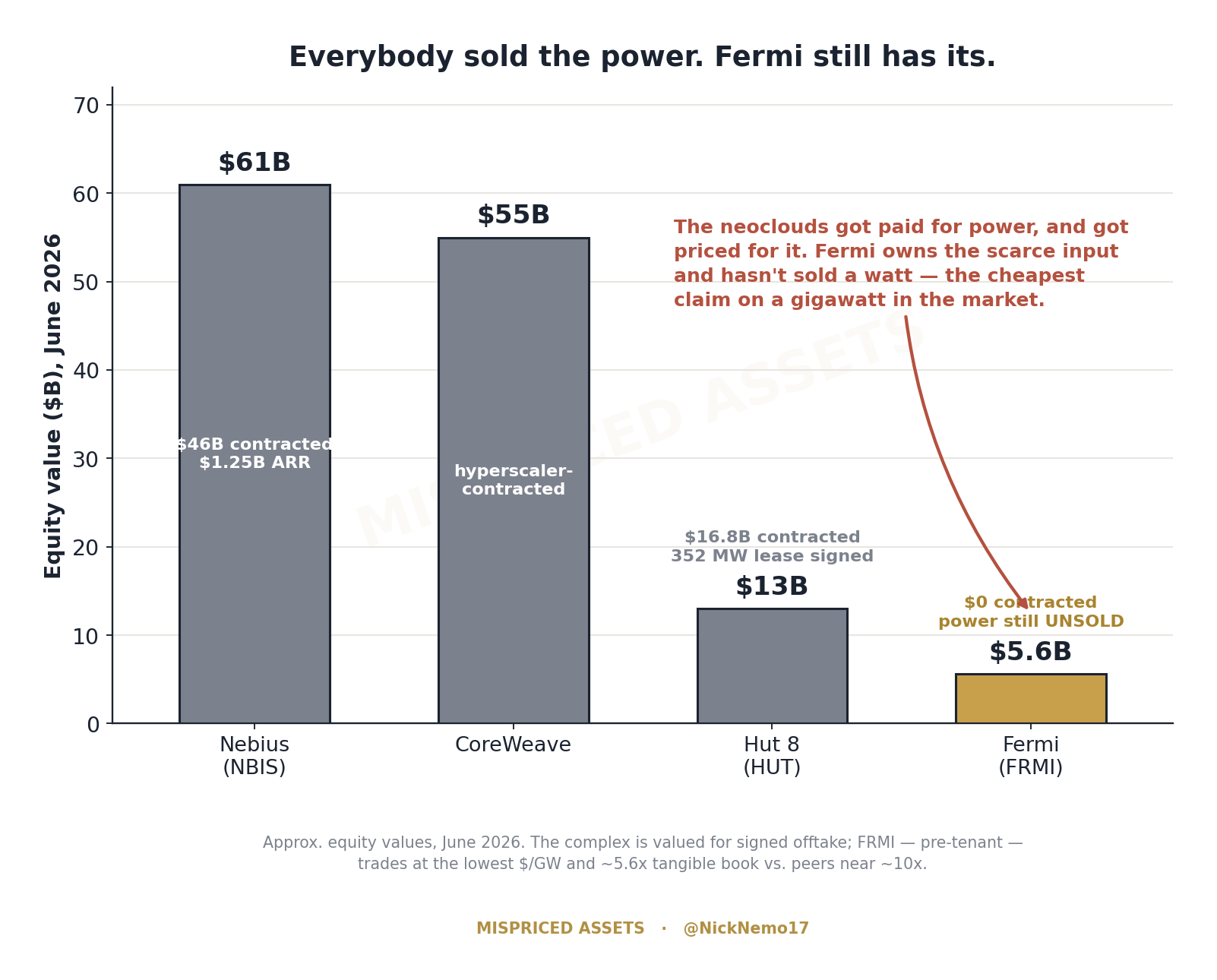
Nebius is worth sixty billion on signed contracts. Hut 8 is worth thirteen billion on one lease. CoreWeave, fifty-five. Each of them got there the same way, by committing capacity and getting paid for the paper. Fermi holds as much power as any of them and trades for about 5.6 times book, against a group closer to ten. You are paying book value for the thing the rest of the industry is fighting over.
The only reason it’s that cheap is that nobody has signed yet.
ONE LEASE IS THE WHOLE GAME
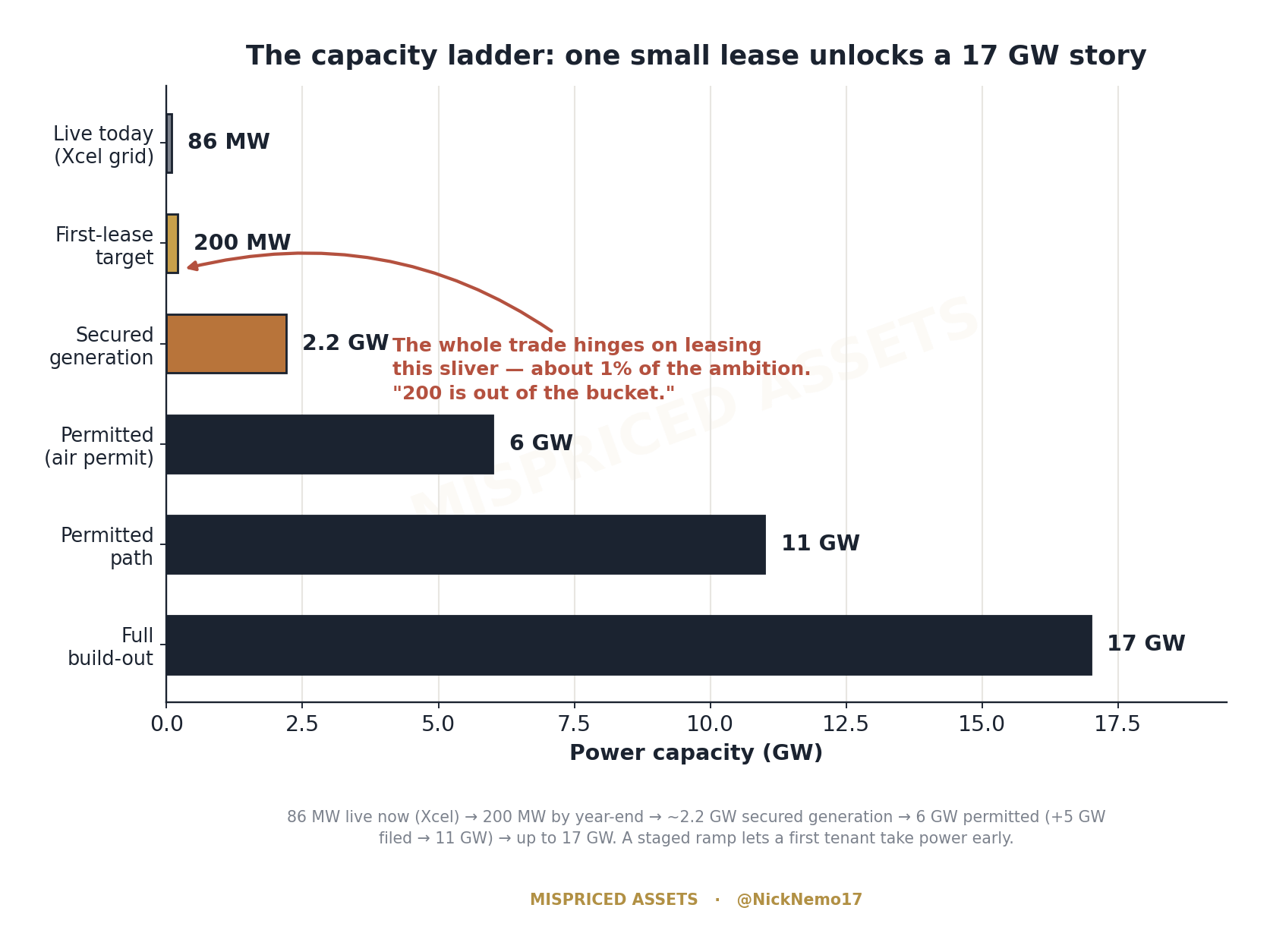
So the whole question is whether a tenant signs, and when. I think the answer is yes and soon, and the reasoning is mechanical rather than hopeful.
Fermi can deliver about 200 megawatts by year-end and ramp toward 1.5 gigawatts through 2027 as the turbines go in. Two hundred is almost nothing against the size of the campus, and management has been open that it will take worse economics — a fifteen-percent return instead of seventeen — to land a first marquee name like Google. The first lease was never really about the megawatts. It’s proof the company can turn all this steel and paper into a contract, and the market would re-rate the whole thing off it. I think a first deal doubles the stock, and given how far the other power names have run on far less, that may be the conservative read.
THE CLOCK
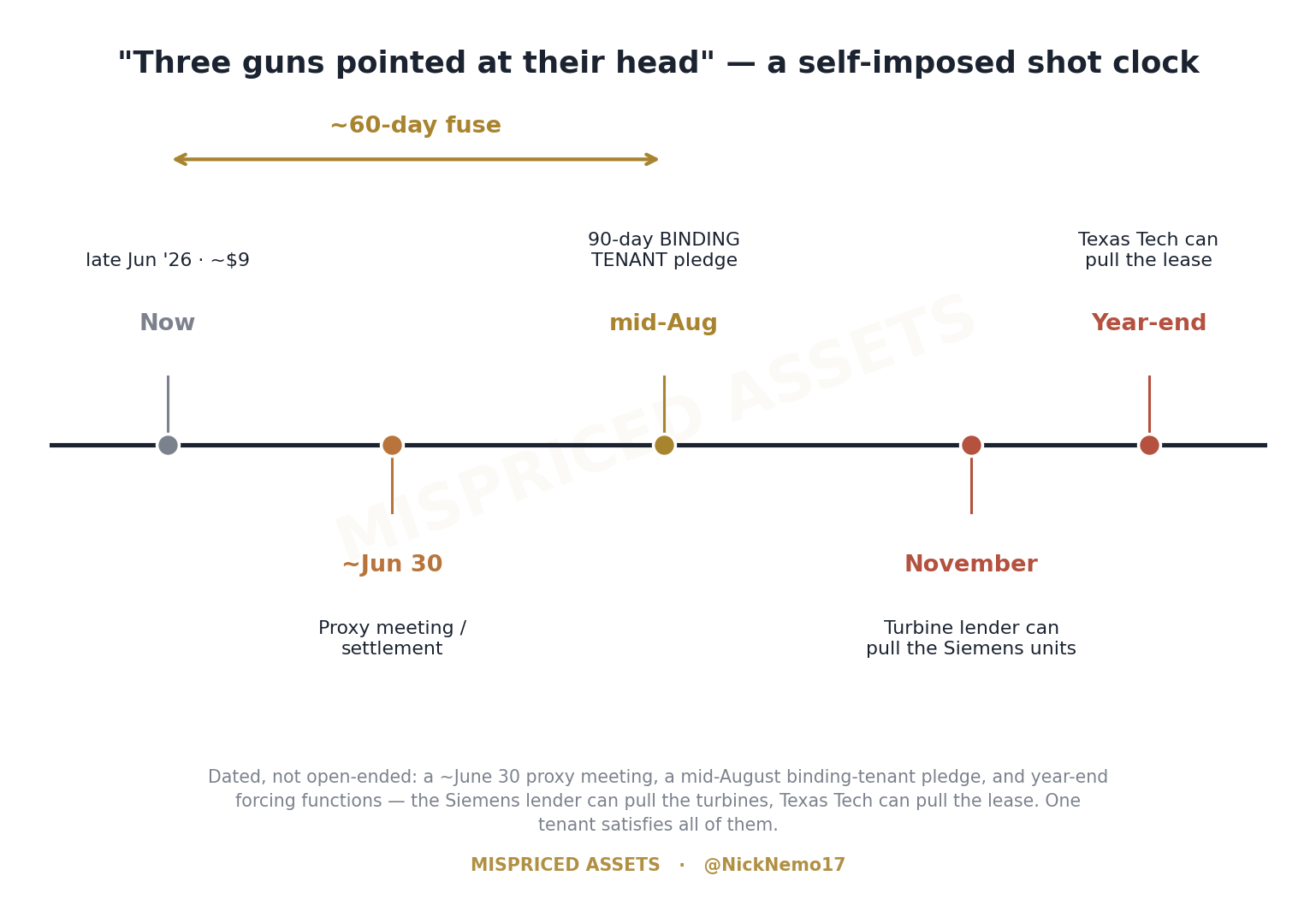
The reason to own it now rather than wait for the proof is that Fermi is running out of room to stall, by its own design. The lender that financed the turbines can begin taking them back in November if there’s no tenant. Texas Tech can pull the ground lease at year-end on the same condition, and the founder’s mess already put the company in technical breach of that lease back in April — the university chose to waive it rather than walk, which tells you whether the landlord still wants this to happen. The proxy fight should settle over the summer; for all the noise, Neugebauer can’t gather the votes to so much as call his own meeting. And in May, management committed on the record to a binding tenant within ninety days, which puts the date in the middle of August.
The governance fight and the missing tenant were always the same problem. No hyperscaler’s risk committee was going to sign a twenty-year lease with Neugebauer across the table, however good the site was. With him gone, the new team says the tenants that walked are back in the data room. That’s what makes the timeline credible instead of wishful.
