

On the first weekend of March 2025, an Associated Press reporter covering the IndyCar opener in St. Petersburg noticed that the best real estate at the race wasn’t a suite. It was a hundred-and-ten-foot Riva moored against Turn 10, first in line, close enough to the track that the new president of Andretti Global had to push through pedestrian traffic to board it and report to work. The yacht is called Cassidy Marie. It is named for the owner’s young wife. The owner is Dan Towriss, and the AP mentioned the boat the way sportswriters mention boats, as scenery. A new Riva 110 Dolcevita runs eleven to fifteen million dollars.
Dan Towriss is not the billionaire in this story; that is Mark Walter, his patron of seventeen years, who owns the Dodgers and just sold the Lakers under duress, and appears on the Forbes list at six billion dollars.
Towriss is an employee. He is the chief executive of Group 1001, the Walter insurance group that holds seventy-six billion dollars of annuity money belonging to roughly half a million people. His salary has never been disclosed in any document. His equity, if he has any, has never been disclosed in any document. Asked once, directly, to say what he owns of the race team he runs, he declined.
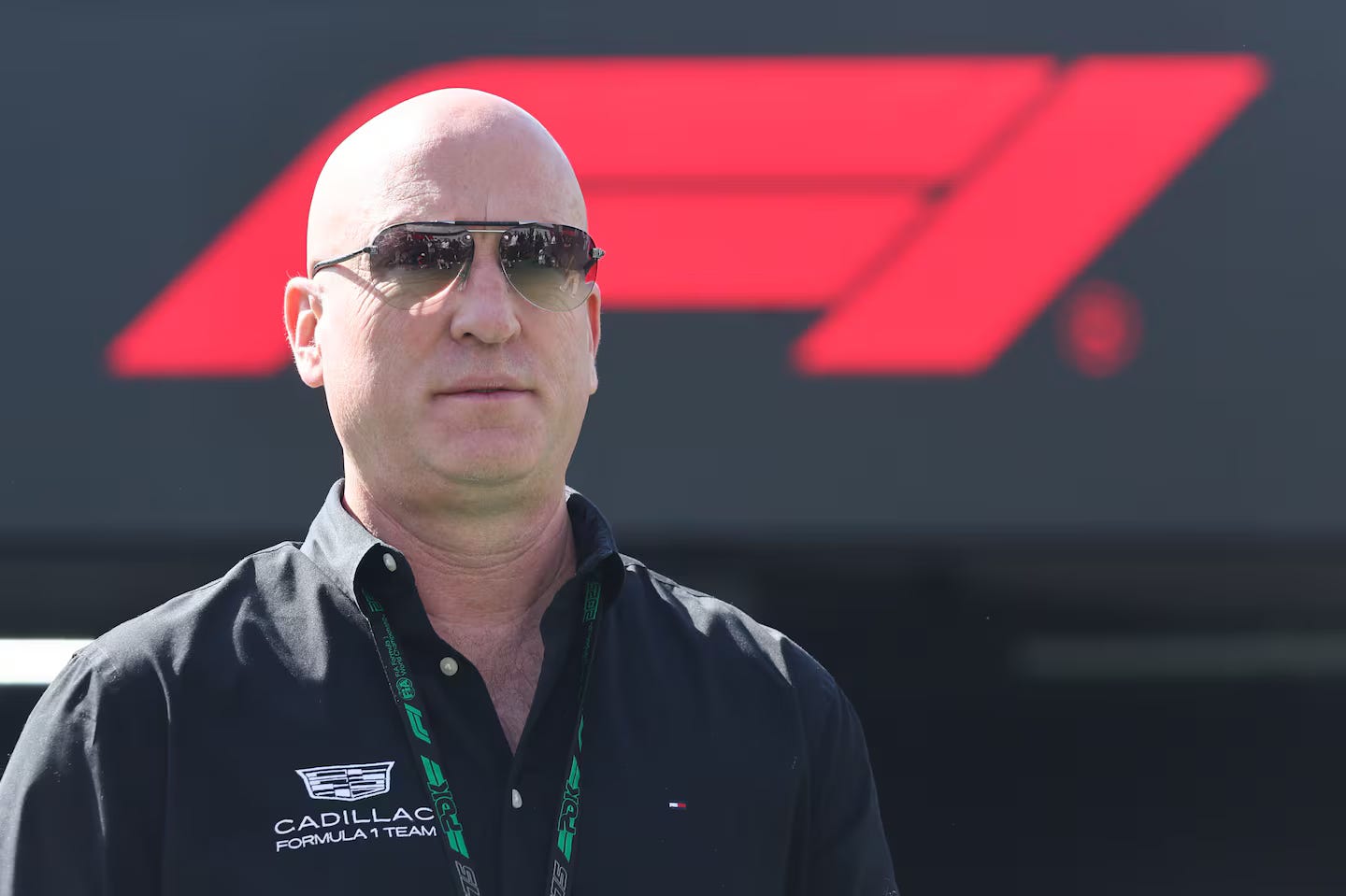
❧ ❧ ❧
Dan’s biography is genuinely good, which is part of what makes it useful. Muncie, Indiana, north side, twelve hundred square feet; mother in radiology at Ball Memorial, father running a small restaurant; a pitching scholarship to Indiana University, a blown elbow, a transfer home to Ball State, an actuarial science degree earned at twenty-one credit hours a semester while working as a surgical assistant. Fellow of the Society of Actuaries.
He came up through Lincoln and ING and Aegon doing the profession’s actual work, pricing what risk costs, and in 2009 Guggenheim Partners hired him to help Mark Walter buy insurance companies. He calls himself a numbers person from Muncie. The hometown magazine ran the story last fall under a photograph of him in the F1 paddock, and it is all true, and none of it answers the question the yacht asks.
What the numbers person did at Guggenheim is on file in a Chicago courthouse. In February 2014, two annuity holders sued Guggenheim’s insurers under RICO, alleging that billions in policyholder money had gone out the door to affiliates, more than a billion of it into the Dodgers purchase, and that the hole was hidden with paper reinsurance ceded to a company called Heritage Life, which the insurers swore in their regulatory filings was unaffiliated. The complaint reprints Heritage’s officer roster. Chief Risk Officer, Chief Actuary, Secretary, and Director: Daniel Jonathan Towriss, who was at that same moment the President and Chief Executive of Guggenheim Life, one of the insurers doing the swearing.
Heritage’s administrative office was Guggenheim Life’s own address in Indianapolis. The insurers told regulators the two companies had nothing to do with each other, and the man running one was four of the officers of the other. The case was withdrawn a day after filing and nothing was ever proven, which left the roster where it had always been, in Heritage’s own statutory filings, not really an allegation so much as a one seat chart.
Twelve years later, the seat chart is intact. Guggenheim Life is called Clear Spring now, and it received a grand jury subpoena in February. Delaware Life, the larger carrier Towriss runs, received one too, and it still cedes a block of structured settlements to Heritage Life of Arizona, the same charter, under a treaty signed in 2020, insurer and reinsurer reunited a generation later like a class reunion.
Delaware Life’s current annual statement asks the question the 2014 case turned on, whether any reinsurer listed as non-affiliated is in fact controlled, directly or indirectly. The answer filed is No. The statement that finally moved seventeen billion dollars from the unaffiliated column to the affiliated one went out this June over the sworn attestation of the company’s officers, and the first name on it is Daniel Jonathan Towress.
❧ ❧ ❧
The machine itself was described here in July, in The Cash Machine, which ran the week Bloomberg revealed the grand jury and did the counting the companies declined to do: the Dodgers’ television network held as the insurers’ single largest position and filed as a stranger, some two hundred and thirty shell borrowers with invented names, the trusts tracing to old partners, the CLOs where the insurer is quietly both lender and manager.
Whatever that timing was worth, the weeks since have been loud. AM Best cut its outlook on all three life carriers within days. Fitch called the restated affiliated exposure the highest it has ever rated in a North American life insurer. Walter agreed to sell the Lakers in about a week, at a two-and-a-half-billion-dollar markup, in a transaction the press has started connecting to his investigation.
That coverage, all of it, orbits Walter, because Walter owns the more famous things. But Walter has never held an insurance license or signed an annual statement. An insurance company is not run by its ultimate controlling person; it is run by an operator, someone licensed and credentialed who employs the actuaries and swears the filings, and for seventeen years, at every entity in this story, the operator has been the same man, the lesser-known Guggenheim insurance man, spending like the famous one.
The spending has a paper trail, even if the income does not. The Fort Lauderdale waterfront house in 2016, $10.4 million, bought, the deed notes, by Daniel and Heather Towriss. The lot next door the following year; the assembled compound is assessed at $18.4 million now, and the local paper observed in passing that the dock was big enough for a hundred-foot yacht, which at the time was a peculiar thing for a dock to be. The yacht arrived in 2021, ten feet longer than the dock’s reputation. In 2022 he put money into Andretti Global that the racing press reported matched or exceeded the quarter billion dollars the team had just raised. In 2024 a new Florida company appeared, Boulder Bay Leasing LLC, manager Daniel Towriss, principal address the Fort Lauderdale house, the sort of entity people create to own the things they float and fly.
What exists inside the statutory filings is the plumbing. Clear Spring, holding about $1.2 billion of surplus, paid its stockholder $135 million in dividends last year and $150 million the year before, while carrying assumed liabilities from the 2014 cast equal to 142 percent of that surplus. Delaware Life paid $30 million of interest on surplus notes whose holders include an entity its own filing calls an affiliate, plus a trust named for the man Towriss replaced as CEO, collecting 8.625 percent. What Guggenheim is paid to manage the whole book is a number the annual statement simply does not contain.
The 2014 complaint, working with subpoena-free public documents, added up $445 million of dividends and $273 million of fees leaving the insurers in three years. The modern filings are more discreet. The money still goes up, and some of it comes down somewhere, and one of the somewheres has a transom with a name painted on it. There may be an ordinary explanation, a salary befitting a man who runs seventy-six billion dollars, and it would take one sentence from the company to give it. The sentence has never been offered, and no one has asked.
❧ ❧ ❧
There is one night on which the numbers person’s own risk pricing is on the record. A day before 2020, off Fort Lauderdale, Towriss drove a brand-new forty-two-foot boat into the Port Everglades jetty at speed. The boat was a million dollars, so new it had not yet been registered, and titled not to him but to a company called Willow Ridge Development, LLC. Everyone aboard went onto the rocks. A friend of the family named Lauren Silagyi came off them with a fractured skull and needed two brain surgeries. The suit her family brought says the evening involved a cocktail, a share of two or three bottles of wine, and another drink at the wheel; Florida filed five misdemeanor charges, including culpable negligence. He pleaded not guilty. And then the record performs its signature trick: the docket runs through discovery and goes dark in 2023, no plea, no verdict, no settlement ever reported, and the profiles written since, the ones about Muncie and grit and Formula 1, do not contain the word “jetty.”
An actuary is a person society pays to know, before the event, what recklessness costs states, policyholders and executives. On New Years Eve 2019, the cost landed on the passengers, as it often does.
His then girlfriend was aboard that night, with minor injuries. Cassidy Rudman, of Kansas City, was twenty-two when they met; he was forty-four, and the deed on the house still said Heather. In Indianapolis it is said she worked for him, and his own version, offered cheerfully to IndyCar’s website, is close enough: she was the Octagon agency’s account executive on his golf sponsorship, standing behind him at his first public event, “my earpiece telling me what to say.” They married in October 2020, ten months after the crash and one month after the charges, and the Riva delivered on roughly their first anniversary carries her name. She is now the Cadillac Formula 1 team’s Chief Brand Advisor. She approves the livery. There are professional photographs on her public Instagram of her cutting a cake with Terry Crews, who appears in the team’s promotional productions; there is Dior on the race-weekend packing list, a paddock-magazine cover, a pair of Nikes the sneaker press noted were made for the two of them and cannot be bought at any price. None of it is hidden. That is what makes it evidence. The lifestyle is not a leak from a private world; it is the public exhibit of a liquidity that no public document explains.
The rest of the org chart rhymes.
His brother Derek, a company actuary for a decade, was made president of the Gainbridge agency in September, the storefront that sells annuities to first-time savers with Caitlin Clark’s face on the marketing.
The chief financial officer, Linda Wang, who also now runs the entire life and annuity business plus information technology, information security, and internal audit, all at once, spent 2014 to 2018 as chief executive of what her biography calls Old Mutual’s Bermuda business. Old Mutual sold that business at the end of 2015 to Beechwood, of Platinum Partners fame, which sold it in 2017 to Greg Lindberg’s Global Bankers; it ended in liquidation beside Lindberg’s other Bermuda shells, owing policyholders a billion dollars. The chief operating officer arrived from a 777 Partners insurer.
The board of Delaware Life, guardian of half a million retirements, is three retired company men, one of whom also appears on Heritage’s 2014 officer roster.
And in the months between the whistleblower and the subpoenas, while a conventional company would have been hiring outside directors and independent counsel, this one promoted the twenty-six-year company lawyer, the CFO, and the brother. Under subpoena, most institutions reach outward for credibility. This one pulled the doors shut.
❧ ❧ ❧
The law waiting at the end of this is not exotic.
Title 18, Section 1033 makes it a federal crime for anyone in the insurance business to knowingly make a false material statement or report to a state regulator, or a false entry in any book or statement, with intent to deceive about financial condition. Ten years a count; fifteen if the falsity jeopardized the insurer and helped push it into conservation or liquidation.
Alongside it sit wire fraud at twenty years a count, the civil penalties of Section 1034 at fifty thousand dollars per violation or the gain, whichever is greater, and, for the licensed, the quiet provision 1033(e), which bars anyone convicted of a felony involving dishonesty from the business of insurance for life. For a man whose entire biography is the license, that subsection is the whole ballgame.
No one has been charged, and investigations end quietly all the time. But the sentencing comparable is fresh. Greg Lindberg, whose company once bought the company Linda Wang was running, pleaded guilty to moving roughly two billion dollars of insurance money into his own affiliated businesses while telling regulators otherwise, and in May he was sentenced to twelve years. Set his plea beside Delaware Life’s own restatement and the documents read as the same sentence with the numbers changed. The Group 1001 version is ten times the size.
❧ ❧ ❧
The 2014 complaint called the Guggenheim insurers a cash machine, and the pieces published on Mispriced Assets have traced the machine and the buyers it trained. A machine, though, does not swear its own filings. For thirteen years the schedules said unaffiliated, and this June they said otherwise, and across both answers, the 2014 roster and the 2026 jurat, the wine-dark water and the women’s-sports halo, the constant is one Muncie actuary who measured every risk in the book except the one he was. The label moved twenty-two billion dollars. The hand that signed it was Daniel Jonathan Towress.
❧ ❧ ❧
If you know something. The filings only contain what someone chose to write down; the rest is people. If you worked inside Group 1001, Delaware Life, Clear Spring, Gainbridge, or Guggenheim, hold or sold one of these annuities, or watched the money arrive in racing, write to nick@wyandanch.consulting. Anonymity is always honored, sources never named without consent, no detail is too small.
No one at Group 1001, TWG Global, Guggenheim, or their affiliates has been charged with any crime; the companies say they are cooperating with investigators and that their financial condition remains strong, and investigations end without charges all the time. The 2014 complaint’s allegations were never proven and the case was dismissed without adjudication; the Heritage officer roster it reprints comes from Heritage’s own statutory filings. Mr. Towriss pleaded not guilty to all charges arising from the 2019 boat accident and through counsel denied being intoxicated; the civil allegations were never adjudicated in any public record located, and no outcome of either case has been publicly reported. The account of Ms. Towriss’s early work is Mr. Towriss’s own, as told to IndyCar.com; the description of her public profile is drawn from her public Instagram and published features, and she is accused of nothing. Ms. Wang has not been accused of wrongdoing; the account of her prior employer’s ownership comes from the acquirers’ own announcements, and her biography’s wording is quoted from Group 1001’s releases. The characterization of Mr. Towriss’s personal finances is inference from public records, stated with its evidence; his compensation and equity are private. All statutory figures are parsed from the companies’ own filings and reconciled to the printed totals.
You're on fire, Nick. An engaging, easy-to-follow article. You're doing us all a valuable service by exposing this rot.
WOW @Michael Burry @Kakashii @bad.robot this is the group that announced a JV with Palantir one day before entering Formula 1, and the numbers went to the roof.
But the GM/Palantir JV does not start in 2025. Starts in 2021 with a data trader called Wejo, if you have not heard about them is because they were stealing our data and selling it to insurance companies that would raise your policies, or worse, cancel them, until the Federal Trade Commission shut them down. The PIPE of Wejo, the private investment into a public company, is Project Energy Reimagined, chaired by the master developer of the Purdue Research Foundation Discobert Park, and whose COO is the IEDC head of Innovation.
GM reported facing unlimited litigation damages.
https://www.publicnow.com/view/F37401C8A7AB6E8EACAFEE0BBCEC7FC6FB00592AConnected vehicles know more about road infrastructure than many agencies do. Wejo has been a strategic partner with Purdue in developing big data processing techniques and use cases that can be scaled nationally," said Darcy Bullock, the Director of the Joint Transportation Research Center at Purdue University.
"Don't model what you can measure. With Wejo data, there is no guesswork; this is simply what is happening on the roadways right now - wasting zero time gathering data and modeling scenarios." Darcy Bullock, Purdue”
https://businesscloud.co.uk/news/100m-wejo-merger-terminated-still-no-administration/